View all Small breed growth charts
Italian Greyhound Growth Chart
Estimate Italian Greyhound adult weight and compare modeled male and female puppy age ranges in lb or kg. Learn how the formal height reference, household safety and dental care differ from the forecast.
View weight chart (lb & kg)Calculate Your Italian Greyhound Puppy's Adult Weight
Enter your Italian Greyhound puppy's age and current weight for an estimated adult weight range.
Estimated adult weight
Italian Greyhound
At 12 weeks, weighing 3.2 lb
ExampleSample result — enter your puppy’s details to get your own estimate.
7–12 lb
- Unknown sex uses the general adult weight reference
Growth chart
Based on published breed standards and growth-curve data. Every estimate is a range, not a single number. Read the methodology and sources
Accuracy note: this model has not yet been validated against a hold-out set of measured adult weights, so no hit-rate is claimed.
Estimates vary. This calculator is a guide, not a guarantee. Consult your vet for health advice.
Current weight sits within this model’s typical range for this age (about 2.4–4.1 lb).
This is a model reference, not a body-condition score or health diagnosis.
Based on this breed’s typical maturity around 48 weeks.
Reflects input completeness, not a probability of accuracy.
Based on typical Italian Greyhound growth patterns, your puppy may weigh 7–12 lb as an adult. At 34% of expected adult weight, your puppy still has some growing to do.
Why this estimate?
- Age and current weight were compared with a small-size growth curve.
- The estimate was anchored to the general adult range for Italian Greyhound.
- Prediction confidence describes input completeness, not a statistical guarantee.
- Typical-for-age comparisons use this model’s reference band, not a body-condition or health diagnosis.
Italian Greyhound weight by age
Typical male and female puppy weight ranges by age, available in lb and kg. Individual puppies may vary.
This Italian Greyhound table uses about 11 months as a model maturity reference, not an individual growth deadline.
These estimated ranges combine the breed's adult weights with a size-based growth curve. They are not measured breed-specific percentiles or health targets. Month labels are rounded approximations; use the week values for each row. How these weight ranges are calculated
Estimated growth curve
Typical Italian Greyhound weight range by age, based on Small growth patterns.
Shaded band: estimated typical weight range
Estimated from the breed’s adult weight range and size-based growth curves — not measured breed percentiles. Individual puppies vary.
How this model estimates Italian Greyhound growth
This chart uses an adult Italian Greyhound reference range of 7–12 lb (3.2–5.4 kg). This is not a healthy-weight target for an individual dog. Males usually run 8–12 lb and females 7–11 lb. The model uses about 11 months as a maturity reference, not an individual deadline.
For Italian Greyhound, the model's midpoint is about 2.3 lb at 8 weeks, 3.2 lb at 12 weeks, and 4 lb at 16 weeks, or about 42% of its adult reference midpoint. Near 6 months, the modeled midpoint is about 5.8 lb, or 61%. These are calculated examples, not measurements collected from puppies of this breed.
The selected size-based curve spreads growth more evenly across its age points. Real measurements may rise unevenly; the smooth curve is a model assumption. Use these figures to understand the model, not to set feeding amounts or judge body condition. Enter your puppy's current age and weight above for an estimated range. Ask your veterinarian about health concerns.
Understanding your Italian Greyhound's growth
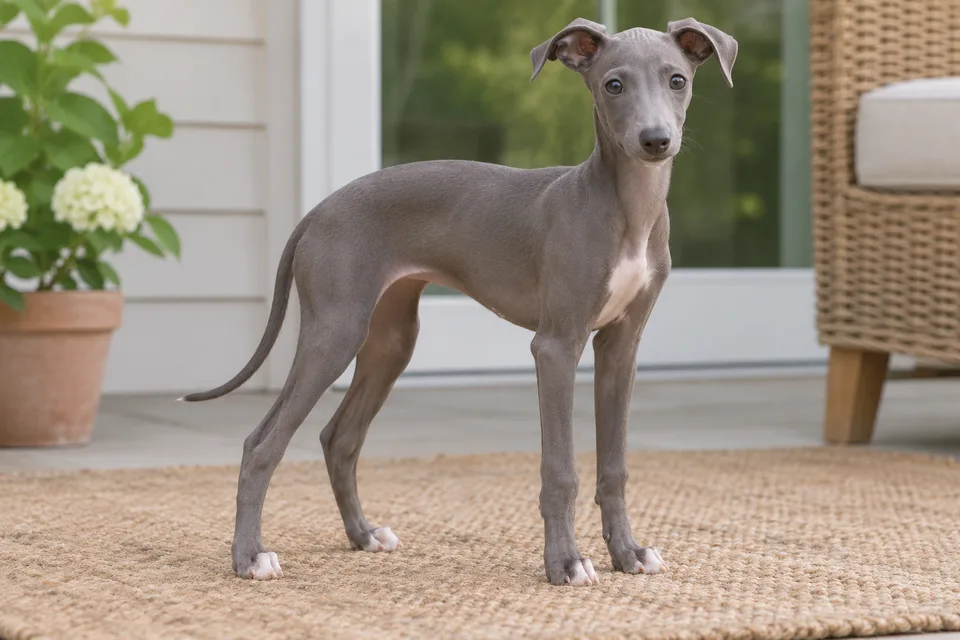
A small sighthound still has its own reference
The formal standard gives an ideal shoulder height of 13–15 inches without a numerical weight range. This page’s 8–12 / 7–11 lb bands and Small curve are tool settings. They should not be replaced by Whippet or Greyhound figures simply because the outlines look similar.
Sources: American Kennel Club: Official Standard of the Italian Greyhound (PDF)
Watch for household falls as confidence grows
The Italian Greyhound Club of America highlights the risk of puppies leaping from furniture and situations that can lead to leg injury. Supervise the home environment and ask for safe handling guidance. A growth percentage or enthusiasm to jump cannot establish that a landing is safe.
Sources: Italian Greyhound Club of America: About the Italian Greyhound
Dental care remains important with a short coat
The club emphasizes oral care even though coat grooming is relatively simple. Ask your veterinary team about an appropriate dental routine and changes in the mouth. Neither a slender silhouette nor steady weight establishes healthy teeth, and the calculator cannot assess body condition from visible ribs.
Sources: Italian Greyhound Club of America: About the Italian Greyhound
Sources and model limits
These sources cover adult breed references and the care topics cited above. The age-by-weight table, growth curve and maturity timing are model estimates, not measured puppy percentiles or findings from these sources. Read how the estimate works.
- American Kennel Club: Official Standard of the Italian Greyhound (PDF) — Conformation reference; not measured puppy percentiles or a clinical weight target.
- Italian Greyhound Club of America: About the Italian Greyhound — Household safety and oral-care context; no jumping program, feeding prescription or diagnosis.
Sources checked .
Common mistakes when estimating your Italian Greyhound's adult weight
Do not apply Whippet weights to an Italian Greyhound or declare visible ribs normal from breed appearance alone. Confidence jumping from furniture is not proof of safe development, and a weight curve cannot assess teeth or injury risk.
Italian Greyhound Growth Stages
These approximate, size-based stages provide context for your Italian Greyhound puppy. The age bands are not individual deadlines or tests of physical or behavioral maturity.
Neonatal
0–2 weeksEarly care and growth need close attention from the caregiver and veterinarian. A weight estimate cannot assess a newborn puppy’s care needs.
Socialization
3–12 weeksLearning about people and surroundings is separate from weight gain. Ask your veterinarian or qualified trainer about suitable experiences for your puppy.
Juvenile
3–6 monthsRecord measured weight as your puppy develops. A change in appearance or coordination does not establish how much adult growth remains.
Adolescent
6–10 monthsThe model may show slower weight gain, but it cannot determine reproductive maturity, behavior or readiness for demanding activity.
Young Adult
10–12 monthsThe weight model approaches its adult reference. An individual dog may continue developing, and a chart cannot confirm completion of skeletal or muscular growth.
Adult
12+ monthsThis label marks the timeline’s adult reference. It does not prove that an individual dog has finished growing; continue to discuss weight and condition changes with your veterinarian.
Italian Greyhound FAQ
How much may my Italian Greyhound weigh as an adult?
This model uses 8–12 lb for males and 7–11 lb for females. It combines these references with age and measured weight; the formal standard does not prescribe these pound bands.
Can I use the Whippet growth chart for my Italian Greyhound?
Use the Italian Greyhound record for this breed. Their related outlines do not make the adult references interchangeable; this record uses its own Small curve and bands.
Are visible ribs always normal in an Italian Greyhound puppy?
No blanket answer is appropriate. A slender breed outline cannot establish an individual puppy’s body condition. Discuss concerns or unexplained weight change with your veterinarian.
Can growth progress tell me whether jumping off furniture is safe?
No. The breed club highlights household situations that can lead to leg injury. Supervise the puppy and seek safe handling guidance; the calculator cannot clear a jump.
Does the 48-week model reference mean my Italian Greyhound is fully mature?
It is approximately 11 months and controls this record’s growth model. Dental care, safe activity and individual physical development need separate attention.