View all Giant breed growth charts
Great Pyrenees Growth Chart
Estimate Great Pyrenees adult weight and compare modeled puppy age ranges in lb or kg. Learn why height-linked standard examples, a thick coat and rear dewclaws need separate interpretation.
View weight chart (lb & kg)Calculate Your Great Pyrenees Puppy's Adult Weight
Enter your Great Pyrenees puppy's age and current weight for an estimated adult weight range.
Estimated adult weight
Great Pyrenees
At 12 weeks, weighing 22.7 lb
ExampleSample result — enter your puppy’s details to get your own estimate.
83–128 lb
- Unknown sex uses the general adult weight reference
- Giant breed growth varies more and may continue for up to 24 months
Growth chart
Based on published breed standards and growth-curve data. Every estimate is a range, not a single number. Read the methodology and sources
Accuracy note: this model has not yet been validated against a hold-out set of measured adult weights, so no hit-rate is claimed.
Estimates vary. This calculator is a guide, not a guarantee. Consult your vet for health advice.
Current weight sits within this model’s typical range for this age (about 19–27 lb).
This is a model reference, not a body-condition score or health diagnosis.
Based on this breed’s typical maturity around 104 weeks.
Reflects input completeness, not a probability of accuracy.
Based on typical Great Pyrenees growth patterns, your puppy may weigh 83–128 lb as an adult. At 22% of expected adult weight, your puppy still has some growing to do.
Why this estimate?
- Age and current weight were compared with a giant-size growth curve.
- The estimate was anchored to the general adult range for Great Pyrenees.
- Prediction confidence describes input completeness, not a statistical guarantee.
- Typical-for-age comparisons use this model’s reference band, not a body-condition or health diagnosis.
Great Pyrenees weight by age
Typical male and female puppy weight ranges by age, available in lb and kg. Individual puppies may vary.
This Great Pyrenees table uses about 24 months as a model maturity reference, not an individual growth deadline.
These estimated ranges combine the breed's adult weights with a size-based growth curve. They are not measured breed-specific percentiles or health targets. Month labels are rounded approximations; use the week values for each row. How these weight ranges are calculated
Estimated growth curve
Typical Great Pyrenees weight range by age, based on Giant growth patterns.
Shaded band: estimated typical weight range
Estimated from the breed’s adult weight range and size-based growth curves — not measured breed percentiles. Individual puppies vary.
How this model estimates Great Pyrenees growth
This chart uses an adult Great Pyrenees reference range of 85–120 lb (39–54 kg). This is not a healthy-weight target for an individual dog. Males usually run 100–120 lb and females 85–100 lb. The model uses about 24 months as a maturity reference, not an individual deadline.
For Great Pyrenees, the model's midpoint is about 17.5 lb at 8 weeks, 23 lb at 12 weeks, and 27 lb at 16 weeks, or about 27% of its adult reference midpoint. Near 6 months, the modeled midpoint is about 38 lb, or 37%. These are calculated examples, not measurements collected from puppies of this breed.
The selected size-based curve spreads growth over a longer period. It does not establish whether an individual puppy's build or growth rate is healthy. Use these figures to understand the model, not to set feeding amounts or judge body condition. Enter your puppy's current age and weight above for an estimated range. Ask your veterinarian about health concerns.
Understanding your Great Pyrenees's growth
The standard ties weight examples to shoulder height
The formal standard associates about 100 lb with a 27-inch male and about 85 lb with a 25-inch female, with weight proportional to overall structure. These are height-linked examples, not universal minimums. This page’s 100–120 / 85–100 lb bands add model endpoints that the standard does not prescribe.
Sources: American Kennel Club: Official Standard of the Great Pyrenees (PDF)
Remember the rear double dewclaws
The standard identifies double dewclaws on each rear leg. The Columbia Cascade Great Pyrenees Club highlights their care because overlong claws can catch and tear. Ask a veterinarian or groomer to demonstrate appropriate nail care; the growth chart cannot assess a claw injury or explain a limp.
Sources: American Kennel Club: Official Standard of the Great Pyrenees (PDF), Columbia Cascade Great Pyrenees Club: Care, Feeding, Training
Do not use the white coat to estimate pounds
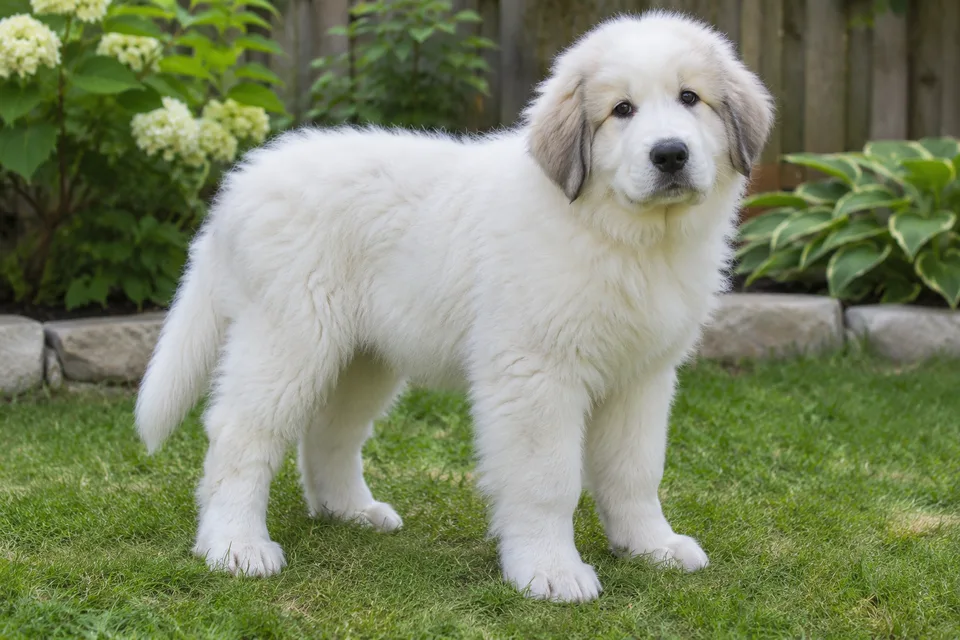
The standard explicitly distinguishes the coat’s visual effect from the underlying bone and muscle. Track measured weight rather than a photo’s outline. A fluffy puppy does not need a numerical coat adjustment, and unexpected physical changes deserve a separate assessment.
Sources: American Kennel Club: Official Standard of the Great Pyrenees (PDF)
Sources and model limits
These sources cover adult breed references and the care topics cited above. The age-by-weight table, growth curve and maturity timing are model estimates, not measured puppy percentiles or findings from these sources. Read how the estimate works.
- American Kennel Club: Official Standard of the Great Pyrenees (PDF) — Adult conformation reference, not measured puppy percentiles or a health target.
- Columbia Cascade Great Pyrenees Club: Care, Feeding, Training — Dewclaw care context; not a source for puppy growth percentiles.
Sources checked .
Common mistakes when estimating your Great Pyrenees's adult weight
The standard’s 100 lb and 85 lb examples are tied to particular adult heights, not minimum weights a puppy must reach. Do not turn the model’s upper endpoints into limits or infer weight from the volume of a white coat.
Great Pyrenees Growth Stages
These approximate, size-based stages provide context for your Great Pyrenees puppy. The age bands are not individual deadlines or tests of physical or behavioral maturity.
Neonatal
0–2 weeksEarly care and growth need close attention from the caregiver and veterinarian. A weight estimate cannot assess a newborn puppy’s care needs.
Socialization
3–12 weeksLearning about people and surroundings is separate from weight gain. Ask your veterinarian or qualified trainer about suitable experiences for your puppy.
Juvenile
3–8 monthsRecord measured weight as your puppy develops. A change in appearance or coordination does not establish how much adult growth remains.
Adolescent
8–18 monthsThe model may show slower weight gain, but it cannot determine reproductive maturity, behavior or readiness for demanding activity.
Young Adult
18–24 monthsThe weight model approaches its adult reference. An individual dog may continue developing, and a chart cannot confirm completion of skeletal or muscular growth.
Adult
24+ monthsThis label marks the timeline’s adult reference. It does not prove that an individual dog has finished growing; continue to discuss weight and condition changes with your veterinarian.
Great Pyrenees FAQ
How big will my Great Pyrenees get?
The page uses adult references of 100–120 lb for males and 85–100 lb for females. Enter your puppy’s age, sex and measured weight for a model interval; individual frame size and growth can differ.
Are 100 lb and 85 lb official minimum weights?
No. The formal standard associates those approximate weights with a 27-inch male and a 25-inch female. It relates weight to structure rather than setting universal pound minimums.
Is 120 lb the official maximum for a male Great Pyrenees?
No. That endpoint belongs to this model’s reference band. A result outside a model band does not itself establish a health problem or a conformation fault.
Why does the Great Pyrenees chart use about 24 months?
The configured maturity reference is 104 weeks. It helps organize this Giant-size model; it is not an individual growth deadline or a test of physical readiness.
Do rear double dewclaws change the weight estimate?
No. They are a breed feature requiring separate nail-care attention. Ask for help if a claw catches or appears injured; the chart cannot assess paws or gait.