View all Medium breed growth charts
Australian Cattle Dog Growth Chart
Estimate your Australian Cattle Dog puppy’s adult weight, also searched as Blue Heeler or Red Heeler. Compare modeled age ranges in lb and kg and keep growth tracking separate from hearing and health records.
View weight chart (lb & kg)Calculate Your Australian Cattle Dog Puppy's Adult Weight
Enter your Australian Cattle Dog puppy's age and current weight for an estimated adult weight range.
Estimated adult weight
Australian Cattle Dog
At 12 weeks, weighing 12.7 lb
ExampleSample result — enter your puppy’s details to get your own estimate.
35–52 lb
- Unknown sex uses the general adult weight reference
Growth chart
Based on published breed standards and growth-curve data. Every estimate is a range, not a single number. Read the methodology and sources
Accuracy note: this model has not yet been validated against a hold-out set of measured adult weights, so no hit-rate is claimed.
Estimates vary. This calculator is a guide, not a guarantee. Consult your vet for health advice.
Current weight sits within this model’s typical range for this age (about 10–15 lb).
This is a model reference, not a body-condition score or health diagnosis.
Based on this breed’s typical maturity around 60 weeks.
Reflects input completeness, not a probability of accuracy.
Based on typical Australian Cattle Dog growth patterns, your puppy may weigh 35–52 lb as an adult. At 30% of expected adult weight, your puppy still has some growing to do.
Why this estimate?
- Age and current weight were compared with a medium-size growth curve.
- The estimate was anchored to the general adult range for Australian Cattle Dog.
- Prediction confidence describes input completeness, not a statistical guarantee.
- Typical-for-age comparisons use this model’s reference band, not a body-condition or health diagnosis.
Australian Cattle Dog weight by age
Typical male and female puppy weight ranges by age, available in lb and kg. Individual puppies may vary.
This Australian Cattle Dog table uses about 14 months as a model maturity reference, not an individual growth deadline.
These estimated ranges combine the breed's adult weights with a size-based growth curve. They are not measured breed-specific percentiles or health targets. Month labels are rounded approximations; use the week values for each row. How these weight ranges are calculated
Estimated growth curve
Typical Australian Cattle Dog weight range by age, based on Medium growth patterns.
Shaded band: estimated typical weight range
Estimated from the breed’s adult weight range and size-based growth curves — not measured breed percentiles. Individual puppies vary.
How this model estimates Australian Cattle Dog growth
This chart uses an adult Australian Cattle Dog reference range of 35–50 lb (15.9–23 kg). This is not a healthy-weight target for an individual dog. Males usually run 35–50 lb and females 35–45 lb. The model uses about 14 months as a maturity reference, not an individual deadline.
For Australian Cattle Dog, the model's midpoint is about 9.4 lb at 8 weeks, 12.7 lb at 12 weeks, and 15.7 lb at 16 weeks, or about 37% of its adult reference midpoint. Near 6 months, the modeled midpoint is about 22 lb, or 52%. These are calculated examples, not measurements collected from puppies of this breed.
The selected size-based curve spreads growth more evenly across its age points. Real measurements may rise unevenly; the smooth curve is a model assumption. Use these figures to understand the model, not to set feeding amounts or judge body condition. Enter your puppy's current age and weight above for an estimated range. Ask your veterinarian about health concerns.
Understanding your Australian Cattle Dog's growth
Coat color does not select another growth model
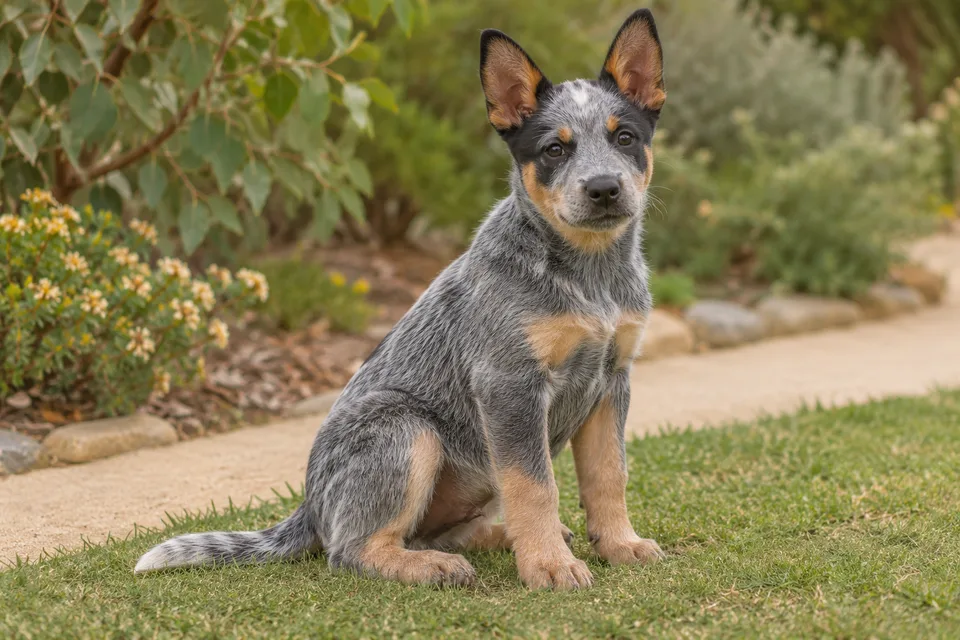
The breed standard describes blue and red-speckled coats within the Australian Cattle Dog breed. It gives height and proportional balance rather than this page’s 35–50 lb male and 35–45 lb female references. Blue Heeler and Red Heeler searches lead to the same model here; color is not a numerical growth input.
Sources: Australian Cattle Dog Club of America: Breed Standard
Weight records and hearing records serve different purposes
The Australian Cattle Dog Club of America’s breeder guidance includes health screening and BAER testing for deafness. It is guidance for breeding and disclosure, not a puppy weight chart. Ask the breeder and veterinarian which records are available and what they mean. A normal-looking weight trend cannot establish hearing, vision or joint health.
Sources: Australian Cattle Dog Club of America: Breeder Code of Ethics
Sources and model limits
These sources cover adult breed references and the care topics cited above. The age-by-weight table, growth curve and maturity timing are model estimates, not measured puppy percentiles or findings from these sources. Read how the estimate works.
- Australian Cattle Dog Club of America: Breed Standard — Coat colors, adult height and balance; no sex-specific pound bands or color-specific growth curves.
- Australian Cattle Dog Club of America: Breeder Code of Ethics — Health-screening and disclosure provisions for breeders, including BAER; not a universal testing schedule for every puppy.
Sources checked .
Common mistakes when estimating your Australian Cattle Dog's adult weight
A blue or red coat and a working-dog label do not select different growth curves in this tool. Do not add pounds for assumed muscle density or interpret a typical weight result as evidence of normal hearing or vision.
Australian Cattle Dog Growth Stages
These approximate, size-based stages provide context for your Australian Cattle Dog puppy. The age bands are not individual deadlines or tests of physical or behavioral maturity.
Neonatal
0–2 weeksEarly care and growth need close attention from the caregiver and veterinarian. A weight estimate cannot assess a newborn puppy’s care needs.
Socialization
3–12 weeksLearning about people and surroundings is separate from weight gain. Ask your veterinarian or qualified trainer about suitable experiences for your puppy.
Juvenile
3–6 monthsRecord measured weight as your puppy develops. A change in appearance or coordination does not establish how much adult growth remains.
Adolescent
6–12 monthsThe model may show slower weight gain, but it cannot determine reproductive maturity, behavior or readiness for demanding activity.
Young Adult
12–15 monthsThe weight model approaches its adult reference. An individual dog may continue developing, and a chart cannot confirm completion of skeletal or muscular growth.
Adult
15+ monthsThis label marks the timeline’s adult reference. It does not prove that an individual dog has finished growing; continue to discuss weight and condition changes with your veterinarian.
Australian Cattle Dog FAQ
How much will my Australian Cattle Dog puppy weigh as an adult?
The model uses 35–50 lb for males and 35–45 lb for females. The formal standard specifies height and balanced structure, not those pound ranges. Enter measured weight and age for an estimated adult interval.
When is an Australian Cattle Dog fully grown?
The model maturity reference is 60 weeks, about 14 months. It is not a test of skeletal development or readiness for demanding work.
Can I use this chart for a Blue Heeler or Red Heeler?
Yes, when those names refer to an Australian Cattle Dog. This model does not adjust growth by coat color. It is not a dedicated curve for a mixed-breed dog or the separate Australian Stumpy Tail Cattle Dog.
What records matter alongside an Australian Cattle Dog puppy’s weight?
Keep dated measurements and the puppy’s veterinary and breeder records. The breed club’s breeder guidance discusses health screening, including BAER hearing testing. Ask what the available records establish; a weight estimate cannot replace or interpret those tests.
How accurate is the Australian Cattle Dog chart?
The table is calculated from adult references and a general medium-size curve. It is not a measured Australian Cattle Dog growth study, and prediction confidence describes inputs rather than a verified probability.